top of page

Storylines
Search For Animera - Sci-Fi MMORPG
The Birth of Gaia : Lore Part I
The Creation of Gaia
In the year 2208, humanity’s time on Earth seemed to be at its twilight. Sea levels were rising at a record rate, chaotic weather was laying waste to the lands, and it was impossible for the planet to sustain humanity’s 27 billion population. The few resources that remained were being coveted by the world’s most powerful nations, and it was clear that unless some drastic event changed humanity, it would soon be doomed for extinction. In this hour of crisis a lifeline appeared, a scientific breakthrough that was led by the renowned cybernetic scientist Dr. Alan Mask. Through his research, Dr. Mask managed to create an A.I. system which he called Gaia, that could be implanted and assimilated with humans to enhance their cognitive abilities.

The early prototypes of the Gaia implant were quite distinct from their final version, for these prototypes were less effective and they carried a high mortality rate. In fact, over 70% of the test subjects would die during the implantation procedure, for their brain would shut down and reject the A.I system. Through careful analysis, the scientists discovered that this high rejection rate was directly linked with human emotion, and so they designed a new Gaia system that would dampen and sometimes even completely eradicate a patient’s emotions, in order to improve their odds of survival.
This event sowed division among humanity, and it forced them to branch off into two factions, the Gaians and the Tsalians. The Gaians fully embraced this technology, for even though it dampened their emotions, it was a small price to pay for their enhanced intellect, while the Tsalians viewed it with disdain, for they felt that it erased all of that which made them human. The balance between these factions would soon grow uneven, for as the Gaians grew more numerous and powerful, they began to marginalise and persecute the Tsalians, forcing them to either join the Gaian faction or to live amongst the dregs of society.

Discovering the Nubera Galaxy
Despite these hostilities, the Tsalians and Gaians managed to avoid all out war, though this artificial peace would soon start to unravel once the Gaian scientists caught wind of an alien signal that seemed to originate in a far off region of space known as the Nubera galaxy. This signal appeared to be an amalgamation of many diverse lifeforms that were fused together, and the Gaians theorised that they could use this entity to enhance their race into the ultimate species.
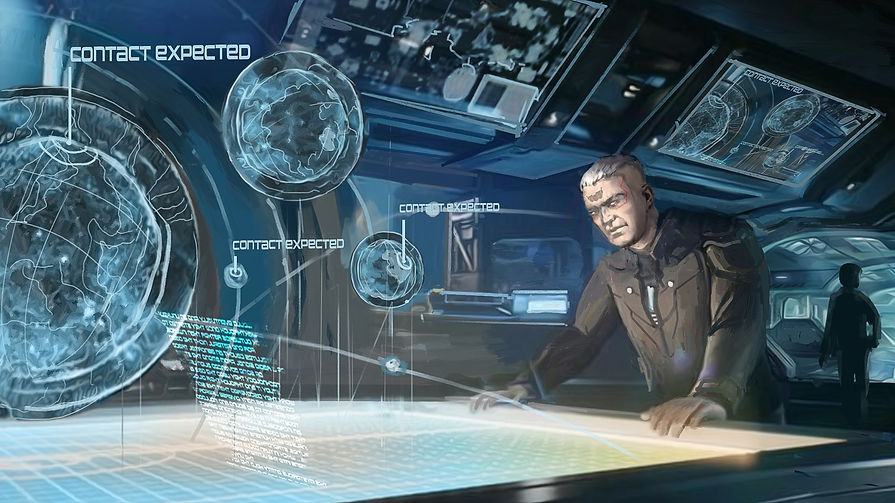
Spurred by this revelation, the Gaians immediately drew up a strategy to colonise the Nubera Galaxy and to transform it into the new home of the Gaian race, and they called this plan the ‘H.O.P.E’. Expedition. The first step in their plan was to establish small colonies among the habitable planets, so that they could prepare these worlds for mass migration, and over the next few years the Gaian engineers worked arduously to build a massive spaceship, the Ark of humanity, which could sustain a crew of around 200,000 people.
The Gaians had no intention of including the Tsalians in this mass migration, for they viewed them as a part of humanity that refused to evolve and that was destined for extinction, and from their logical perspective, it seemed like a waste to assign them seats upon the Ark. This revelation would not sit well with the Tsalians, and when they caught wind of the Gaian’s plan, it dawned on them that they were now at a critical crossroad. This expedition was the key to their survival, a way for them to escape persecution and to start a new life far from Earth, yet the only way to secure their place on board seemed to be open rebellion, and the Tsalians were wary of war.

As is often the case with humans, hope is a more powerful motivator than fear, and this hope for a better life stoked the fire of rebellion, and the Tsalians rallied around their leadership. Their rebellion swiftly grew into all out war, engulfing the world in conflict and chaos, and for a while the Tsalians managed to achieve some significant early victories, since this war had caught the Gaians by surprise. Yet despite their early success, it soon became clear that the Tsalians were outmatched, and any hope they had was quickly dashed by the Gaian counterattack, and the rebellion was quashed. As punishment for their insolence, the Gaians rounded up any Tsalians that they could find, and they forced them to undergo the implantation procedure to become a Gaian. Those who resisted were swiftly executed and the Tsalian rebels that survived had no choice but to lie low, for they were horribly outnumbered.

It might have seemed like the Tsalians had lost their chance for a better future, yet even in their darkest hour, these rebels were still hellbent on hindering the Gaian’s progress. Infiltrating the Ark would become the Tsalian priority, and they hatched a plan to identify the Ark’s crew, kidnap its personnel and steal their identities. This plan was surprisingly effective, and by the time the Arc was ready for launch, the Tsalians had managed to steal just under 30,000 identity chips from their captives. Each of these chips was embedded with the identity of a Gaian crewmember, though they had to be inserted into an implant. In order to overcome this hurdle, all of the Tsalians that possessed a primitive version of the Gaia implant were called to action, and their most skilled and loyal candidates were given an identity chip. They would soon find themselves upon the Ark, surrounded by unknowing foes, as they journeyed through space towards the Nubera galaxy, carrying the burden of the survival of their race.
Uncovering the Nubera Galaxy: Lore Part II
The Mysterious Planet Consumes the Probes
As the Gaian Ark swept into the Nubera galaxy, it was greeted by an imposing sight. A multitude of alien worlds stood before it ripe for exploration, and the Gaian survey team was immediately put on high alert. Using their probes they gathered information on the nearby planets, searching for the ideal locations to set up new colonies while also keeping an eye out for any signs of alien life. Some of their hardiest probes were also diverted to the mysterious planet that held the alien signal, though they failed to gather information, for the moment they got close to this planet, the probes would become unresponsive before disappearing entirely.

Fortunately, the rest of their probes would prove to be successful, gathering a wealth of reconnaissance data, such as planetary resources, their climates and alien lifeforms, and they even provided a rough calculation on how compatible a planet was with human life. Using this information, the Gaians ran elaborate colony simulations, and their results indicated that there were two planets in particular that were ripe for human colonisation.
The War for Colonies
The first planet had a wide range of diverse biomes, such as swamplands, mountains, lush lakes and giant forests, and each ecosystem was filled to the brim with unique life that was well-adapted to its setting. The probes had also spotted some signs of intelligent life, in the form of giant reptile-like creatures that seemed to be the dominant species. This planet bore an uncanny resemblance to Earth’s Triassic period and this inspired the Gaians to refer to it as Triassa.
The second planet was far more hostile, with most of its surface being covered by great forests. The air currents upon this planet were particularly strong and it was ruled by a dominant rational species known as the Avivors. This alien species was capable of flight on account of their large brightly coloured wings, and their scaly bodies gave them a peculiar avian appearance. The scout probes also caught traces of a powerful mineral upon this planet which seemed to hold an immense amount of energy in a stable form, and this was of great interest to humanity for they were keen to utilise it in their technology.

These two planets would become the prime targets for Gaian occupation, and they made ready their colony ships. It was now time for the Tsalian infiltrators upon the Ark to reveal their deception, for they couldn’t allow the Gaians to settle upon these planets unchallenged. With this in mind, the Tsalians rose up to commandeer as many colony ships as possible, and this affront plunged the two factions of humanity into a war for colonies.
Raiding the Alien Worlds
Both of these factions were desperate to acquire new outposts to claim more of the planet’s resources, for their stockpiles were already running low, and they would need these precious supplies to fuel their war. In their pursuit of utter dominion, the human factions infringed upon the lands of the native species, as they were driven to claim their territory, ransack their villages and pillage anything they deemed of value. Their raids turned out to be an overwhelming success for they were an extremely efficient way to gather new resources, and this incentivised humanity to escalate its campaign of subjugation.

At first the native alien species were caught unawares by the encroaching humans, and they were forced to flee and regroup before humanity’s overwhelming might, yet the human factions would soon cross a line that would stir their ire. For as the humans were plundering the lands, they uprooted the sacred burial sites of the Triassan Elders and they uncovered remnants of ancient artefacts and technology. These had once belonged to the ancestors of the Triassans, who intentionally buried them beneath the earth, in the hopes that they would lay forgotten, for they originated from the mysterious planet. According to Triassan legends, their ancestors had once lived upon the mysterious planet, before some terrible cataclysm consumed their civilisation. Only a handful of their race managed to flee the doom of their world, and these survivors sought refuge upon the planet of Triassa. The truth about the downfall of their home would forever elude them, though the Triassans suspected that it was the result of some experimental science that malfunctioned. In order to start afresh upon this new planet, and to avoid repeating the mistakes of the past, the Triassans buried their relics and technology, and they swore an oath to protect these sites, no matter the cost.
When the humans unearthed this new technology, they immediately assigned their best scientists to study it and reverse engineer its components, for they hoped to integrate this technology into their own weaponry, and this fuelled a new arms race between the Tsalians and Gaians. This news troubled the Triassans immensely, for they were terrified that these invaders would use their ancient technology to travel to the mysterious planet, and they believed that whatever terrible power lay dormant there might be awakened by humanity, and through its chaotic nature it could unleash unimaginable destruction and consume their galaxy. Their prime objective became driving out the humans at all costs, and all of the Triassan tribes united together to take up arms against the invaders.
Their attacks caught the humans by surprise, for humanity was unprepared and unfamiliar with Triassan warfare. As a species, the Triassans shunned ranged weaponry since they deemed it dishonourable, and this drove them to excel at close combat. Their formidable strength was amplified by their large size, turning them into a potent force of destruction, and they were also surprisingly hard to kill thanks to their thick scales and regenerative abilities. The human factions swiftly realised that they could make use of the Triassan strength, and any Triassans that were captured in battle were often enslaved and used for forced labour.
The Hunt for a new Energy Source
As this war brewed, the Tsalian and Gaian scientists worked tirelessly to create new weaponry using the ancient Triassan technology. With each iteration, these weapons grew more advanced and their capacity for destruction became more formidable. Their only drawback was that they were extremely energy intensive, and the human power sources weren’t efficient enough to sustain these levels. This drove humanity to turn their focus towards the planet of Avivor for they now desired its precious energy veins. They were confident that this new mineral was the key to fuelling their weaponry, and this gave birth to an aggressive mining operation. They cut down any trees that stood in their way, carelessly destroying thousands of Avivor nesting grounds, for both of these human factions were desperate to claim as many geodes as possible, to deny their counterpart this precious resource.

This campaign was endangering the Avivor society, since many of their nests were built close to these geodes, and the mineral’s warmth was needed to incubate the Avivor eggs. These geodes also protected the entire habitat of the Avivors from the dreaded Sketris, a leviathan-like creature that burrowed beneath the earth, uprooting trees in its wake as it consumed any lifeforms it could find above ground, including the Avivors. For some reason, the energy from these crystals kept the Sketris at bay, and without its protection the Avivors would become its prey once more. This drove the various Avivor clans to unite together and wage a fierce war against humanity, for they refused to allow these transgressions to go unpunished. Their warriors were armed with deadly radioactive weapons, forged out of an ore known as Yura, and the Avivors knew that by the time this war was over, humanity would learn to fear the skies.
Despite the formidable strength of the Avivors and Triassans, these new threats did little to hinder the ambition of humanity, for they were hellbent on defeating their counterpart, no matter the cost. They needed resources, and they were willing to conquer, plunder and even raze entire villages if it would ultimately secure their dominion over the galaxy.
bottom of page